Understanding AI
Your guide to the essentials of artificial intelligence, explained simply.
Understanding Artificial Intelligence
At Growth of AI, we break down complex AI topics into clear, approachable insights for learners at every level.


Our Mission
What We Cover
We cover AI’s history, core ideas, real-world uses, ethical questions, and future possibilities in an easy-to-understand way.

History and Evolution of Artificial Intelligence (AI)
1950 – Alan Turing proposed the Turing Test to evaluate machine intelligence.
1956 – The term Artificial Intelligence was coined at the Dartmouth Conference by John McCarthy.
1960s–1970s – Early AI programs like ELIZA and SHRDLU focused on rule-based reasoning and language processing.
1970s–1980s – Development of Expert Systems that mimicked human decision-making in specific domains.
1980s–1990s – AI experienced periods known as AI Winters due to limited computing power and high expectations.
1997 – IBM’s Deep Blue defeated world chess champion Garry Kasparov, marking a major AI milestone.
2000s – Growth of machine learning driven by increased data availability and improved algorithms.
2012 – Breakthrough in deep learning when neural networks achieved major success in image recognition.
2016 – Google DeepMind’s AlphaGo defeated a world champion Go player.
2020s – Rise of generative AI, large language models, and widespread AI adoption across industries.

CORE CONCEPTS OF ARTIFICIAL INTELLIGENCE

Data
Foundation of AI
Structured data (tables, numbers)
Unstructured data (text, images, audio, video)
Data quality, bias, and preprocessing
Why it matters: AI systems learn patterns from data; poor data → poor AI.
Algorithms
Rules that guide learning and decision-making
Search algorithms (BFS, DFS)
Optimization algorithms (gradient descent)
Classification and regression algorithms
Why it matters: Algorithms define how AI learns from data
Machine Learning (ML)
Learning patterns from data without explicit programming.
Supervised Learning: labeled data
(e.g., spam detection)Unsupervised Learning: unlabeled data
(e.g., clustering customers)
Deep Learning
Neural networks with many layers
Artificial Neural Networks (ANN)
Convolutional Neural Networks (CNN) – images
Recurrent Neural Networks (RNN), LSTM – sequences
Transformers – language & vision
Why it matters: Powers modern AI like ChatGPT, vision systems, and speech recognition.
Neural Networks
Inspired by the human brain
Neurons, weights, bias
Activation functions (ReLU, Sigmoid, Softmax)
Backpropagation
Key idea: Adjust weights to minimize error.
Computer Vision
Understanding images and videos
Image classification
Object detection
Face recognition
Image segmentation
Optical Character Recognition (OCR)

Uses of AI in REAL WORLD

Healthcare
Purpose: Improve diagnosis, treatment, and operations
Medical imaging (detecting cancer from X-rays, MRIs, CT scans)
Predictive analytics for disease risk (diabetes, heart disease)
Drug discovery and protein folding
Virtual health assistants and symptom checkers
Hospital workflow optimization (bed allocation, staffing)
Impact: Faster diagnosis, fewer errors, personalized care
Finance & Banking
Purpose: Risk management, automation, fraud prevention
Fraud detection in real-time transactions
Credit scoring and loan approval
Algorithmic trading
Chatbots for customer service
Anti-money laundering (AML) monitoring
Impact: Reduced fraud, faster services, better risk control
Retail & E-commerce
Purpose: Personalization and demand optimization
Recommendation systems (Amazon, Netflix)
Dynamic pricing
Inventory and demand forecasting
Customer sentiment analysis
Visual search (search by image)
Impact: Higher sales, better customer experience
Transportation & Logistics
Purpose: Efficiency and safety
Self-driving and driver-assistance systems
Route optimization (Google Maps, Uber)
Fleet management and fuel optimization
Predictive maintenance of vehicles
Traffic management systems
Impact: Lower costs, fewer accidents, faster deliveries
Education
Purpose: Personalized learning
Adaptive learning platforms
Automated grading and feedback
AI tutors and doubt-solving assistants
Plagiarism detection
Student performance analytics
Impact: Better learning outcomes, scalable education.
Business & Office Work
Purpose: Productivity and decision support
Document summarization
Resume screening
Email drafting and scheduling
Sales forecasting
Customer insights from data
Impact: Time savings, better decisions
Everyday Consumer Use
Purpose: Convenience
Voice assistants (Siri, Alexa)
Face recognition on phones
Spam filters
Smart home automation
Language translation
Impact: Easier, faster daily tasks
Cybersecurity
Purpose: Threat detection and prevention
Anomaly detection in networks
Malware classification
Phishing detection
Automated incident response
Identity verification
Impact: Faster response to cyber threats
Manufacturing & Industry
Purpose: Automation and quality control
Predictive maintenance of machinery
Robotic process automation (RPA)
Computer vision for defect detection
Supply chain optimization
Digital twins for simulation
Impact: Reduced downtime, higher quality, lower waste

FUTURE OF ARTIFICIAL INTELLIGENCE
1. Smarter and More Human-Like AI
AI systems will better understand language, emotions, and context, enabling more natural interaction between humans and machines.

2. Artificial General Intelligence (AGI)
Future research aims to develop AI that can learn and perform any intellectual task a human can, moving beyond narrow, task-specific systems.
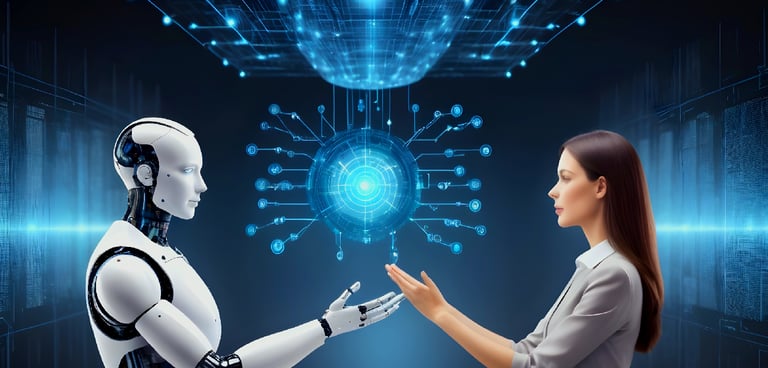
3. Human–AI Collaboration
AI will increasingly act as a co-worker, assisting humans in decision-making, creativity, research, and problem-solving rather than replacing them.
4. Expansion of Generative AI
AI will create high-quality text, images, videos, music, and code, transforming industries like media, education, marketing, and software development.
5. Integration into Everyday Life
AI will become an invisible but essential part of daily life, powering smart homes, virtual assistants, wearable devices, and digital services.